A Day at the TAIH Symposium 2026
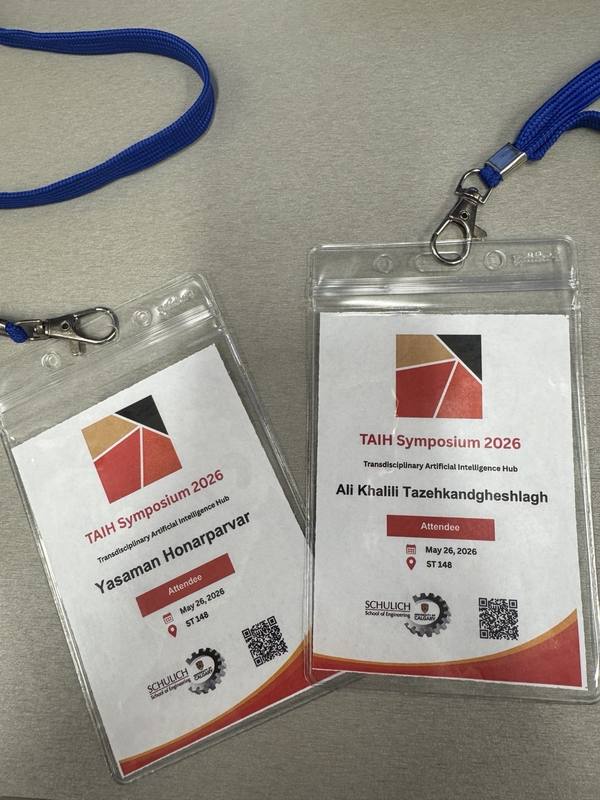
The UbiSensing & AI Lab attended the Transdisciplinary AI for Humans (TAIH) Symposium 2026 at the University of Calgary, where researchers, engineers, and industry leaders gathered for a full day of ideas at the intersection of AI and the human experience. Yasaman Honarparvar and Ali Khalili Tazehkandgheshlagh represented the lab—fresh from presenting at ESE Research Day just days earlier—and here’s what stood out.
Setting the Stage
The symposium opened with welcome remarks from Prof. Samira Ebrahimi Kahou and Prof. Jenny Godley at the University of Calgary’s Science Theatres. The energy in the room made one thing clear from the start: this wasn’t just an academic exercise. The work on display had real stakes—in hospitals, power grids, classrooms, and beyond.
Industry Perspectives: When AI Meets the Real World
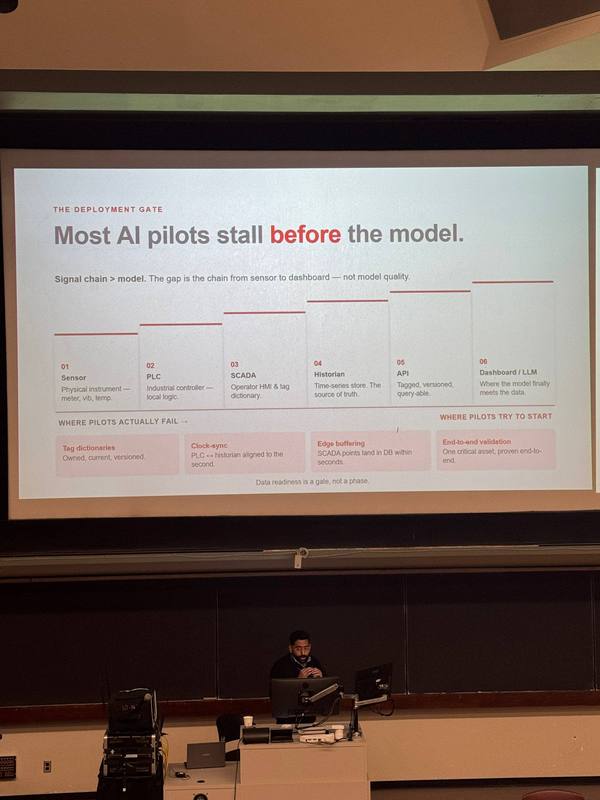
One of the morning’s most grounding moments came from Enerva’s invited talk on AI-driven Measurement & Verification. The core argument was refreshingly honest: most AI pilots don’t fail because of bad models—they fail because the data never makes it from the sensor to the dashboard in a usable form. Tag dictionaries, clock synchronization, edge buffering—the unglamorous plumbing that determines whether a project lives or dies.
“Data readiness is a gate, not a phase.” — Enerva talk
Prof. Jessalyn Holodinsky (University of Calgary) followed with the late-morning invited talk, and the afternoon closed with Truman Seto from ENMAX presenting on Power Grid Ontology—specifically, how semantic data joins can make sense of the fragmented data landscape in energy infrastructure. A timely topic as the grid grows more complex.
Posters: Research Up Close
The poster session in the Engineering building was one of the liveliest parts of the day—a chance to go deep on individual projects and talk directly with the researchers. The range was remarkable: from protein therapeutics and biomedical imaging to smart building policy, multilingual pediatric communication, and the question of how AI should support—not replace—human agency in learning.
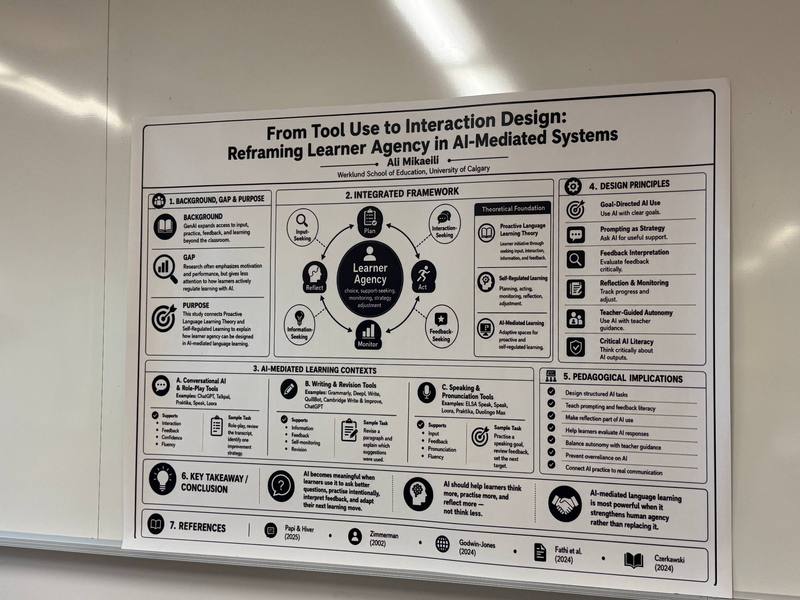
One poster that sparked real conversation asked a fundamental question: what does it mean for a learner to have agency when AI is mediating the experience? Rather than treating AI as a tool to hand students, the framework proposed here positions it as part of an interaction design problem—one where reflection, monitoring, and strategy adjustment are built into the loop.
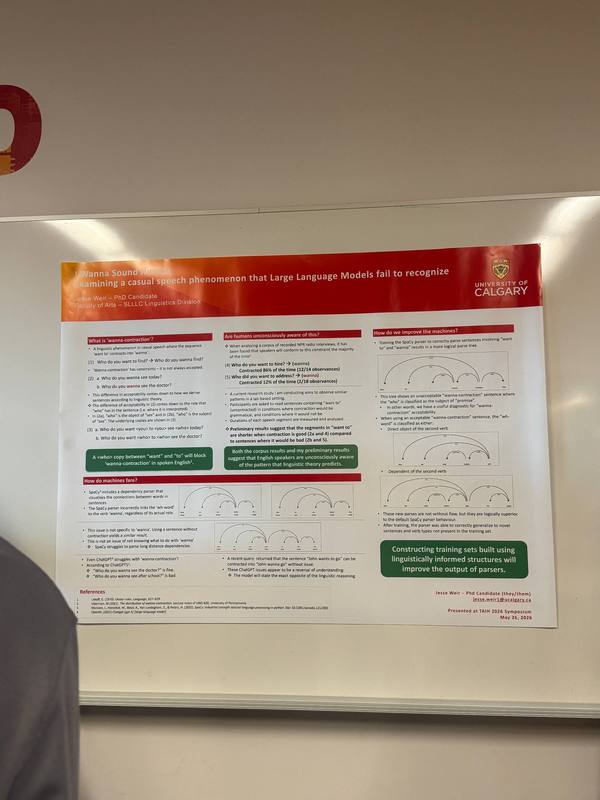
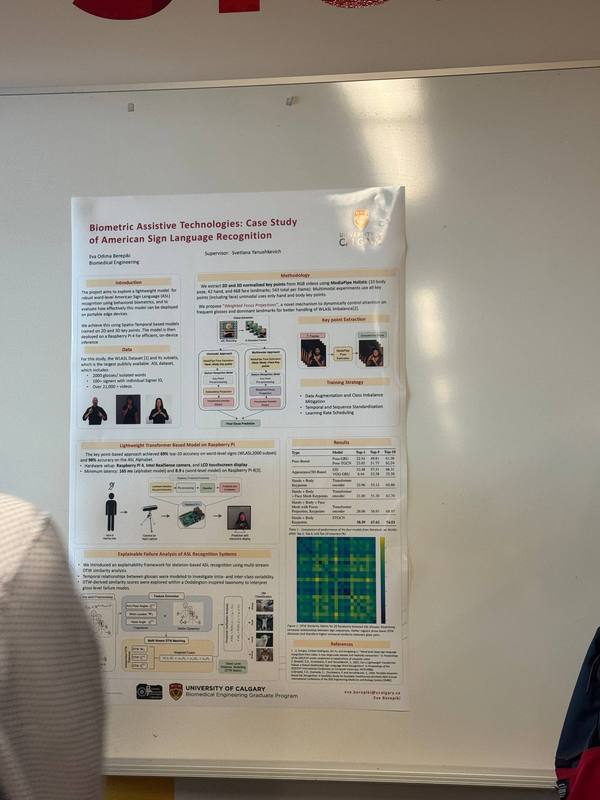
Also on display: a linguistics study showing that LLMs consistently fail to recognize “wanna-contraction”—a contraction that human speakers use automatically and unconsciously. It’s a small but telling example of how surface-level fluency in language models can mask deeper gaps. And on the engineering side, a lightweight transformer model for American Sign Language recognition, designed to run on a Raspberry Pi 4—bringing assistive technology to portable, low-cost hardware.
Afternoon Presentations: The Breadth of AI Research
Thirteen oral presentations filled the afternoon with an impressive sweep of topics—knowledge graphs for uncertainty-aware decision-making, explainable intrusion detection in EV charging infrastructure, reinforcement learning for drone stability under wind, deep learning for skin regeneration modelling, LLMs evaluated as entrepreneurial pitch judges, and more. Each ten-minute slot offered a window into a distinct corner of applied AI research, and the cumulative effect was a vivid picture of just how widely the field has expanded.
What We Took Away
Walking out of Science Theatres, one theme kept echoing: the hardest part of AI isn’t the model—it’s getting the right data to the right place at the right time. That’s a problem we live with every day in the lab, whether we’re building farmer-centered AI through OpenAgSense, designing multi-agent systems for methane data querying, or exploring privacy-preserving health monitoring with MAMAI. It was energizing to see so many groups wrestling with the same challenge from different angles, and we came away with fresh ideas to bring back to our own work.
Enjoy Reading This Article?
Here are some more articles you might like to read next: