Validating LDAR Simulators Using Real-World Data from British Columbia
A comparative study of FEAST and LDAR-Sim using BCER regulatory data (2020–2023) to evaluate how well open-source LDAR simulators reproduce real-world methane emissions.
Objective
Provide the first direct, data-driven evaluation of two widely used open-source LDAR simulators—FEAST (Fugitive Emissions Abatement Simulation Toolkit) and LDAR-Sim (Leak Detection and Repair Simulator)—using real-world regulatory data from British Columbia.
Description
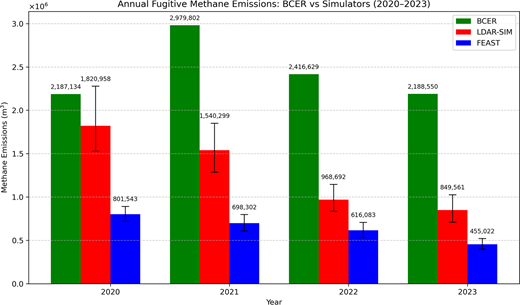
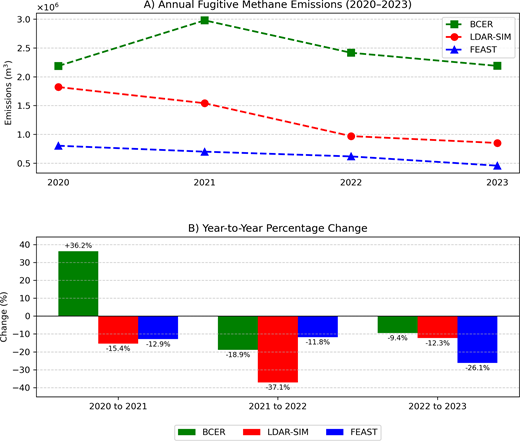
Methane-mitigation policies increasingly rely on simulation tools to design and evaluate Leak Detection and Repair (LDAR) programs, yet the extent to which these models reproduce real-world emissions remains unclear. This study uses a comprehensive regulatory dataset from the British Columbia Energy Regulator (BCER) covering 2020–2023. Simulations were configured to match empirical survey frequencies, optical gas imaging (OGI) detection conditions, and BCER-calibrated leak generation parameters. Annual methane emissions from each model were compared with observed OGI-detectable emissions, and model behavior was assessed through stratified Monte Carlo simulations, bootstrap aggregation, and targeted sensitivity analyses.
Both models systematically underestimated annual emissions and did not reproduce the non-monotonic interannual patterns observed in the BCER records, especially the 2021 peak. The sensitivity analyses indicate that the realism of the repair process—including the timing of repairs and the occurrence of incomplete or delayed repairs—is the primary factor governing model accuracy, with a stronger influence than detection thresholds or survey frequency. LDAR-Sim demonstrated greater robustness by sampling repair delays from empirical distributions, while FEAST exhibited higher volatility under realistic repair behavior. The results provide a transparent benchmark for LDAR model evaluation and guidance for enhancing simulation fidelity to support methane-mitigation policy design.
Project Details
Collaborator(s): Jinya Wang, Zahra Ashena, Mozhou Gao, Sina Kiaei, Steve H.L. Liang
Publication:
- Wang, J., Ashena, Z., Gao, M., Kiaei, S., & Liang, S. H. L. (2026). Validating existing LDAR simulators using real-world data from British Columbia: A comparative study of FEAST and LDAR-Sim. Elementa: Science of the Anthropocene, 14(1), 00089. DOI: 10.1525/elementa.2025.00089 · Article
Date: 2026