OpenAgSense: Trusted AI & Open Data Infrastructure for Canadian Agriculture
A cloud-native, multi-agent platform integrating sensors, satellites, and farmer observations using open standards and FAIR data principles for Canadian agriculture.
Objective
Build a trusted, cloud-native, and interoperable agricultural data infrastructure for Canada that:
- Integrates public environmental data, operational field data, and farmer knowledge into AI-ready intelligence
- Supports drought monitoring, emission tracking, and climate-resilient decision-making
Description
OpenAgSense is a spatio-temporal, cloud-native, open-source, multi-agent AI platform for smart agriculture. It integrates sensors, satellite data, and farmer observations using open standards (e.g. OGC) and FAIR data principles.
Two main research components:
- AI-based integration of multi-source environmental data for drought prediction in Alberta—combining satellite observations, weather stations, and IoT sensors into regionally tuned models.
- Multi-agent crowdsourcing platform—enabling farmer-controlled data sharing and integration of sensor data, satellite information, and farmer observations.
The problem we address: Canada needs trusted agricultural AI—not fragmented tools. Climate volatility is accelerating; droughts, wildfires, and extreme weather are increasing risk. Critical environmental data remain underutilized because farm data are fragmented and locked, and crowdsourced farmer knowledge is rarely integrated with scientific data. OpenAgSense provides a trusted, open data infrastructure to address this.
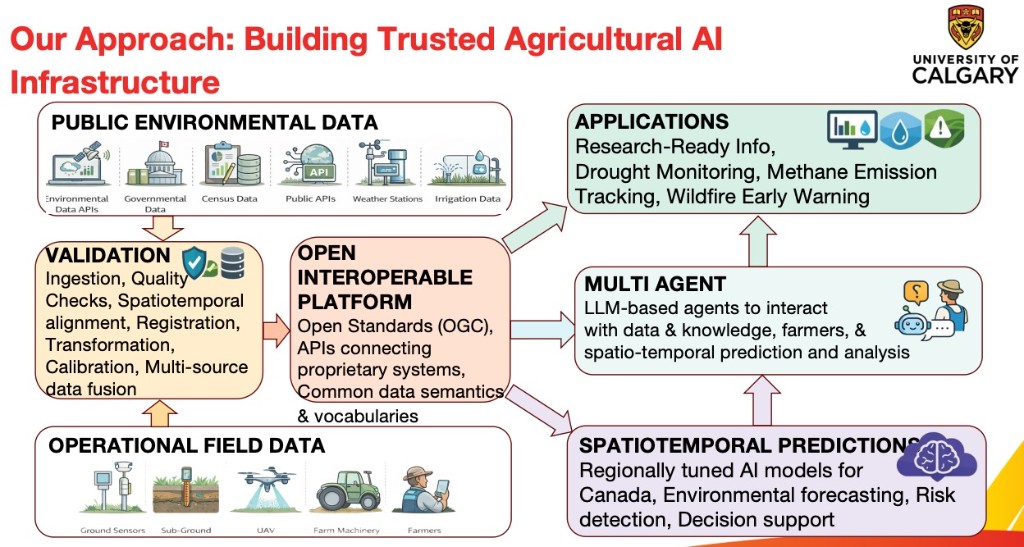
Our Approach: Building Trusted Agricultural AI Infrastructure
-
Data sources
- Public environmental data: APIs, government and census data, weather stations, irrigation data
- Operational field data: ground and sub-ground sensors, UAVs, farm machinery, farmers
-
Validation: Ingestion, quality checks, spatiotemporal alignment, registration, transformation, calibration, and multi-source fusion
-
Open interoperable platform: Open standards (e.g. OGC), APIs connecting proprietary systems, common data semantics and vocabularies
-
Spatio-temporal predictions: Regionally tuned AI models for Canada, environmental forecasting, risk detection, decision support
-
Multi-agent layer: LLM-based agents that interact with data, knowledge, farmers, and prediction outputs
-
Applications: Research-ready information, drought monitoring, methane emission tracking, wildfire early warning
What Makes OpenAgSense Different
-
Farmer trust as infrastructure. Trust is not a policy add-on; it is a technical feature that allows national-scale platforms.
- Permission-based data sharing, transparent governance
- AI runs only on validated data layers
- FAIR-aligned architecture
-
Open standards as national sovereignty. The platform is built on open international geospatial standards.
- Breaks vendor lock-in, enables federal interoperability, future-proofs infrastructure
- The SensorThings API, largely developed by researchers in our lab at the University of Calgary, is a cornerstone of this approach
-
Crowdsourcing: farmers as sensors. Farmers’ knowledge is integrated with scientific and sensor data rather than left untapped.
-
Drought prediction for the Prairies. Prairie droughts directly threaten crop yields, irrigation reliability, and water governance.
- Cross-provincial modeling with geographically representative datasets, national-scale AI training, evidence-based water governance
- Early drought detection, near-real-time soil moisture deficit tracking, regionally tuned AI models for Alberta
- Integration of subsurface sensors and satellite imagery
- Testing at W.A. Ranches (19,000-acre living lab)
Multi-Agent Architecture
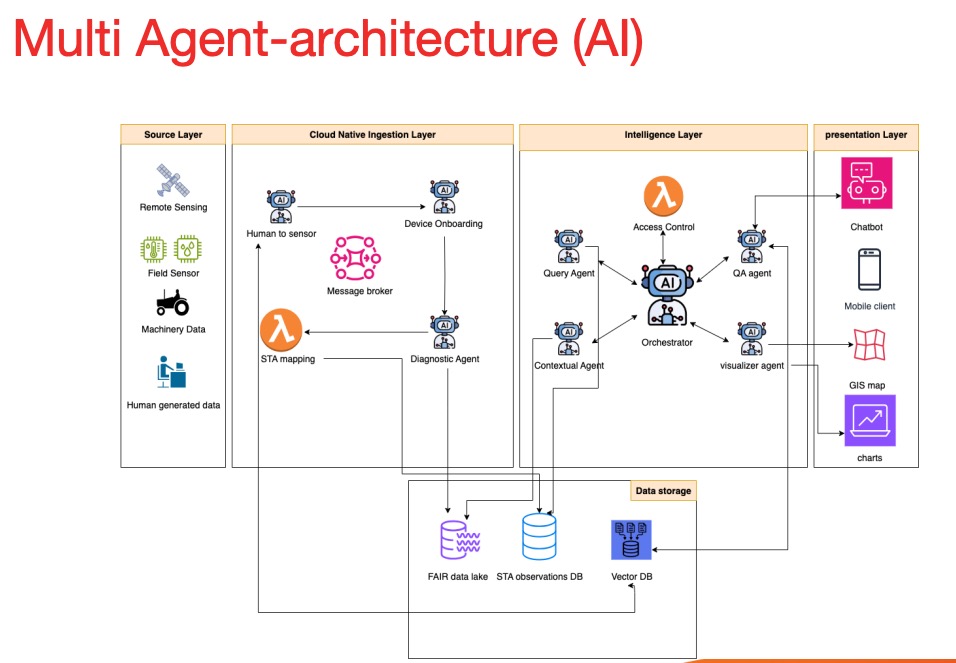
OpenAgSense is implemented as a multi-agent system with shared data storage (FAIR data lake, STA observations DB, vector DB). The architecture has four layers:
-
Source layer: Remote sensing, field sensors, machinery data, human-generated data
-
Cloud-native ingestion layer: AI agents for human-to-sensor mapping and device onboarding; message broker; STA mapping; diagnostic agent that routes validated data into storage
-
Intelligence layer: Orchestrator that coordinates query, contextual, QA, and visualizer agents; access control
-
Presentation layer: Chatbot, mobile client, GIS map, charts
Why This Matters for Canada
- Food & water security—smarter irrigation and drought response
- National AI readiness—high-quality, explainable agricultural datasets
- Rural digital infrastructure—fair design for remote and underrepresented farmers
- Research & policy intelligence—trusted data for provinces, irrigation districts, and researchers
We aim to build a common digital infrastructure for agriculture that enables trusted data sharing, accelerates research, and supports climate-resilient farming across Canada.
Path Forward
To scale nationally, we seek:
- Partnership for pilot expansion
- Integration with federal datasets
- Support for national interoperability standards
- Co-development of policy-aligned AI tools
Project Details
Collaborators: Dr. Sara Saeedi, Yasaman Honarparvar, Sepehr Honarparvar, Kan Luo, Nader Khoshroo
Presentations:
- OpenAgSense: Trusted AI & Open Data Infrastructure for Canadian Agriculture. Presented at the i3A Innovation Showcase, March 4, 2026.
Program: Innovation, Automation, and AI Acceleration (i3A)—an initiative of Agriculture and Agri-Food Canada (AAFC) under its Information Systems Branch and Transformation and Modernization Services. i3A focuses on leveraging AI and automation to develop real solutions for improving service delivery, operations, and scientific work in the government sector.
Date: 2026–ongoing